


Pure and Unadulterated Lies
Written April 2026
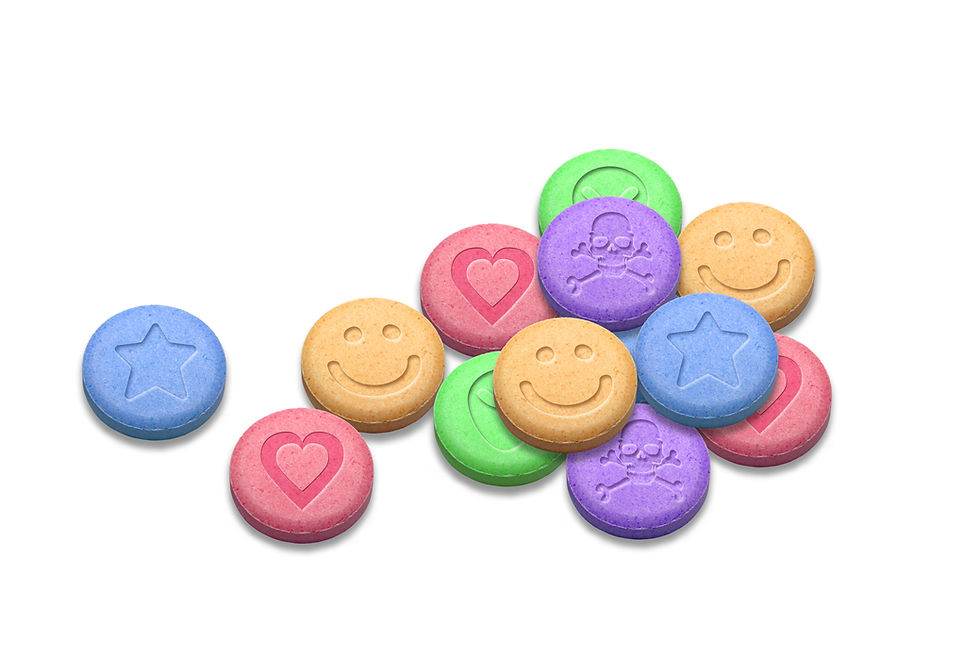
In the heady days of my late teens, I was a college student enjoying the folly of youth, which meant putting the minimum of effort into the incredibly dull course I was studying during the week (admittedly ditching a few lectures to play pool and drink cider in the local) and looking forward to the weekends, which were whiled away with friends at pubs and clubs. We also enjoyed raves of the kind that only 1990s kids will remember, sometimes in an abandoned warehouse, sometimes in a field far outside of London, big all-nighters that left us feeling like we had experienced the Garden of Eden. Happy days. But an abiding memory of that time also was the fear that my poor mum often expressed, that either me or my brother would end up “like that poor girl”. The “poor girl” of my mother’s nightmares was 18-year-old Leah Betts, who reportedly died after taking a single Ecstasy pill at her own 18th birthday party in November 1995.
The Leah Betts story was one of those seminal events that cemented itself in the minds of the public, sitting alongside others such as the murder of James Bulger and the Hungerford Massacre. Such events were usually surrounded by phrases such as “lessons must be learned”, and in many cases led to significant changes to legislation, and often resulted in people modifying their behaviour, lest they should suffer similarly. And, notably, there were striking images linked to each case that were disseminated so widely and so often that they are seared into our memories, and to this day are called instantly to mind when a particular case is mentioned. Almost, one might be forgiven for thinking, like the result of an orchestrated and successful marketing campaign. Readers probably recall the grainy still taken from CCTV footage, showing little James Bulger being led away from the butcher’s shop by the two monsters who supposedly murdered him. Readers may also recall the equally grainy black and white photograph of a blank-eyed Michael Ryan, who allegedly embarked upon a lone-wolf shooting spree in Hungerford, killing 16 people including his own mother, before turning the gun on himself, predictably.
In the case of Leah Betts, the money shot was an image of her lying in a hospital bed, supposedly hooked up to a life support machine, after being blue lighted to hospital following her Ecstasy-induced collapse just hours earlier. Her father, we are told, snapped the photograph using a hospital polaroid camera, and agreed to release the image to the press as a warning to other youngsters who might be tempted to drop a cheeky thrill or two on a Saturday night.
I was born the same year as Leah and celebrated my own 18th just two months before her fateful party, so the story resonated, but something always felt off about it to me. And, I can honestly say that it did not deter us in the rave and club scene, where Ecstasy use continued entirely without issue. [Disclaimer: I am not advocating the use of recreational drugs; but I would personally be far warier of prescribed drugs. Just saying.] But, as with my own Mum, parents were frightened witless, as the campaign used the age-old tactic of assaulting the emotional response system before the critical thinking system has time to engage. With the passage of time, perhaps now we can examine this case with fresh eyes, unclouded by the immediate emotion and horror with which it was initially foisted upon us.
The fateful night of Leah’s party was November 11th, 1995, at her parents’ home in a small village outside of Basildon, Essex. Leah and her friend supposedly took the Ecstasy at around 7.30pm, and at midnight she was allegedly blowing out candles on her birthday cake. Some half-an-hour later, we are told, Leah’s younger brother rushed into the kitchen to tell his mum that Leah was not well. An ambulance was called, and Leah was taken to Broomfield Hospital in Chelmsford, where she was placed on life support after falling into a coma. According to the official story, Leah’s brain had swelled after she supposedly drank – wait for it – 7 litres of water within a 90-minute period. After five days on life support, the decision was made to turn off the machine, but not before Leah’s organs were apparently harvested for donation. More on this later.
There are some immediate red flags (or at least pennies in the coincidence jar) with the Leah Betts story. Her dad, Paul Betts, was a former Metropolitan policeman, and very likely (although I could not confirm for sure) a Freemason. Her stepmum, Janet, was a registered nurse, working in a school and whose job had involved giving talks to her charges about the dangers of drugs. The date of the party, with not one, but two elevens! And there is some interesting etymology around the name. Leah means “delicate”, and Betts is a form of Bartholomew, which means “water abounds”. Spooky or what?
Furthermore, Leah’s birth mother, Dorothy, had reportedly passed away from a sudden heart attack three years before the events of Leah’s 18th birthday, at the age of just 45. She and Paul had been separated since Leah was 3 years old, and Leah had reportedly remained living with her mother and her new husband, Chris, until Dorothy’s untimely death. Perhaps just another coincidence, of course, but sceptics might also point out that it is not difficult for the dark and devious overlords to relocate people who are participating in false events, and provide them with new identities somewhere else in the world.
I recently wrote an article about crisis actors, in which I expressed my disbelief that truly bereaved parents would be in any way capable of facing television cameras in the aftermath of the death of their child. And yet, somehow, in these big stories, they always do. Paul and Janet were no exception, and did not disappoint. Just hours after allegedly flipping the off switch on their daughter’s life support machine, they faced a press conference that had been set up in the hospital, to report that Leah had passed away. I will no doubt face the usual barrage of “not everyone grieves the same way” accusations, but in my opinion, this news conference does not stack up. Paul’s atrocious acting aside, the language is odd, focussing more on heaping praise on himself and Janet for keeping Leah alive long enough that her organs may be donatable than on the surely unbearable grief of Leah’s loss. It beggars belief. As does much of the detail of this case.
A book titled The Party’s Over…Living without Leah was published two years after Leah’s reported death, written by Janet and Paul Betts with the help of a journalist named Ivan Sage. A reading of the book has done nothing to allay the enormous scepticism I already held about this “tragic” story. In fact, the entire book reads like a story made up by someone who has been given the brief of adding meat to the bones of the approved “facts”, but whose ham-fisted efforts instead produced a narrative that is, frankly, trying too hard. It gives the game away in jaw-dropping style. As pointed out by Francis in the recent discussion we had on this subject, the scriptwriters of these events appear to lack an understanding of the human condition, and so create stories bereft of real emotion.
Describing the preparations for the party, Janet remembers that she and Paul “moved our little stash of Christmas sherry, and whisky for ‘medicinal purposes’”, because they were such an innocent family, you see! They would only be providing the teens with “Coke or lemonade, because some of her [Leah’s] friends were under 18”. And, allegedly, after a couple of friends phoned Leah to tell her they couldn’t make the party, Leah “sat on Paul’s knee in the kitchen and began to cry.” I mean, seriously? She was 18, not eight! I’m surprised that Disney didn’t buy the rights to this dross.
We then have some extremely creepy input from Paul, who recalls that, “about 8 o’clock that evening Leah came downstairs with her arms in the air. She spun around in the doorway and said: ‘Will I do?’ She looked absolutely incredible, stunning. If I had been 20 or 30 years younger, I would have fancied her myself.” And he doesn’t stop there. After describing in detail the outfit his daughter was wearing, he concludes, “She looked really tasty.” It doesn’t get any better. Paul goes on to recall that during the party, he popped into the lounge to check on things a couple of times, and that on one such occasion “Leah grabbed hold of me for a dance. It was one of those arms around the neck, arms around the waist type of dances to the song ‘When a Man Loves a Woman’. It was really nice. I think that was one of the closest times, both emotionally and physically, I had ever been to Leah.” Sick bags are available in the seat pocket in front of you.
Quite aside from the nonciness of it all, there are some glaring errors in Paul’s and Janet’s story, which are worth examining. They repeatedly note that while the party was in full swing, they parked themselves in the kitchen watching The Bodyguard, which was on television that night (presumably at high volume, with an 18th party taking place the other side of the door). They go on to state that a photograph of Leah was taken at midnight, as she blew out her candles, and that “Half an hour later we were still in the kitchen, still watching The Bodyguard”, when “Suddenly William came diving through the door: ‘Mum, Leah needs you, she’s not well!’”. Being a bit of a geek, I checked the television schedules for November 11th, 1995. Sure enough, The Bodyguard was indeed shown that evening on LWT, with a start time of 21:00. However, the next item on the schedule, as was usual for a Saturday night, was The Big Fight – Live!, that particular night’s bout being Henry Wharton v Sam Storey (Wharton beat Storey by knockout in the fourth round, for anyone interested), and the start time of this programme was 23:25. So how was it that Paul and Janet were still watching The Bodyguard at half past midnight? Janet then, quite unbelievably, asserts that her initial thought when William summoned her to Leah was “Here we go, she’s had too much to eat.” What kind of 18-year-old did she think Leah was? While you might not instantly think “drugs”, you would almost certainly, in such a situation, think “alcohol”.
The description of the music, too, struck me as slightly odd. Paul tells us that “There was Oasis, REM, and other groups, plus some more smoochy types of records.” In my experience, Ecstasy was very much a drug of the rave scene, taken in clubs and at raves, and house parties too, where dance music was being played. But this just doesn’t sound like the kind of party where kids would be dropping thrills. And did Paul not notice, during his “arms around the neck” dance with his daughter, that her eyes were like saucers? And who plays Percy Sledge at their 18th party?
But most notable about the entire description of the party is that there was not one person who noticed Leah chugging litre after litre of water. How did she achieve this herculean task without anyone noticing? This scene must have been akin to the Lard Ass pie eating contest from Stand By Me for her to have packed it away at that rate. And anyway, I simply don’t believe that it is physically possible for a young, slim girl (as Leah was) to down 12 pints of water, within an hour and half. (Leo conducted his own experiments and couldn’t get close!) Leah’s brother later in the book describes her as popping in and out of the kitchen for food, too. So on top of the 12 pints of water, she’s packed a few sausage rolls in there too? I’m just not buying it. Unless she had hollow legs, it just is not possible.
On to the tragic moments of Leah’s collapse, and we are asked to believe that whilst she is in near delirium, vomiting and screaming in pain, she was able to say to her stepmum “I’ve taken an Ecstasy tablet”. The description becomes even less believable when Paul adds, “I asked Leah who she had got it from. ‘Stephen Smith,’ she replied, adding that this was the fourth or fifth time she had taken Ecstasy.” Well, she certainly sounds pretty coherent for someone who moments later – well, let’s let Paul take up the storytelling once again, “Jan dialled 99- but, before she had dialled the final 9, Leah stopped breathing.” The drama! The pair allege that each gave mouth-to-mouth to Leah, Paul until she vomited and he couldn’t “do this anymore”, and Jan continuing after emptying out Leah’s mouth. Apparently, “Paul has a real aversion to sickness”, something I’d imagine one might overcome in a life and death of your daughter situation.
Curiously, Janet casually states that she was “still giving mouth-to-mouth resuscitation when the police arrived”. There is no mention of who called the police, or why. William, too, mentions the police arriving, even before the ambulance. Continuing the badly-produced drama style, he writes about another party goer trying to hand him something, presumably a pill, and asking him to get rid of it. But our little grass, William, told an intrepid copper, who then “began to search and found something hidden behind the bushes in the garden. ‘That’s what we were looking for,’”. All very Scooby-Doo. If it hadn’t been for that pesky kid…
At the hospital, Leah was hooked up to the life support, and it was allegedly the next day that Paul had the “inspired idea” of giving the gathered media pack the now infamous photograph of Leah. Just a few days later, the family were apparently told that Leah was brain dead, and that they would need to turn off the life support machine. There is no mention of the family questioning this decision or reaching out for second and third opinions. They simply accept, after five short days. As a parent, this just doesn’t ring true to me. I would fight like a tiger, chain myself to the bed and refuse to let go, until every avenue had been explored. I would demand further tests, other doctors. Anything to prolong the life of my precious child.
However, the Betts’ accepted Leah’s fate for her, and set about enthusiastically preparing her for organ donation. Organ donation is a recurring theme in this story, as you will start to see. Fortuitously for the family, just weeks before her premature death, young Leah had telephone her local radio station, BBC Essex, in answer to their appeal for more people to carry organ donor cards. The charitably-minded youngster had been disappointed to be rejected for the scheme, as she was at that time still only 17. How convenient that they had such recent confirmation of Leah’s wishes, eh? In another stroke of luck (or penny for the coincidence jar) Paul and Janet’s good friends, Alan and Jill Rose, were on hand to help them through – and Alan happened to run a company – UK Transplant Limited. Janet notes, “The only consolation we had from Leah’s death was that her organs would be helping six or seven people start a new life, and possibly someone would be helped to see again. Leah’s liver, both kidneys, her spleen, heart and lungs, both corneas and her windpipe were donated.” Such comfort. She also asserts to her readers that should they find themselves in such a position as having to decide whether to donate their own child’s organs, that they should do so, as they “won’t ever regret” the decision. Four hours after Leah’s death, Paul gave the press conference mentioned earlier, where he took the opportunity to yet again hammer home the message about organ donation.
Leah allegedly died in the early hours of the morning of 16th November – that very evening, her dad and stepmum appeared on a BBC programme after being whisked across to a Norwich studio. The following morning, they arrived at Granada Television Studios in Liverpool to appear with Richard & Judy on This Morning, followed that evening by an appearance on Central Television’s Live programme. The very night, and the very next day. Think about that for more than two seconds, and you realise how implausible it really is. Anyone who has experienced grief knows that this is impossible. Doing the rounds of the television studios sounds far more like an exercise in PR than it does grief, and Paul and Janet were the faces of the campaign.
Things get even stranger, impossible as it might sound. Describing Leah in her coffin at the chapel of rest, Janet tells us that Leah was dressed in the “clothes she had worn at the party – even the shoes”. My jaw hit the floor when I read this, there is just so much wrong here. Firstly, those clothes would have been covered in vomit, if the story of Leah’s dramatic collapses is to be believed. Secondly, those very vomit-covered clothes would have been cut off in the ambulance, or at the very least in the hospital when she arrived, as the emergency medical team went to work. Even if the clothes had survived, by some miracle, surely the very outfit your child had worn at the traumatic moments of her collapse into coma would be more than a little triggering, and not the clothes you would want her buried in for all eternity.
At the funeral, Paul’s eulogy to his daughter took the form of a long, bizarre story about a “pretty little ship”, of which he himself was “captain”, that is smashed against some rocks at sea and broken apart, only for the captain to heroically use the “heart and lungs” of his ship to “provide all the essential parts to repair these other boats”. He describes the captain’s “pride for her as he saw her living on in the other boats, and therefore she would be remembered, not only by him but by many other families which she had helped.” He did not mention Leah’s name once, and yet again, as in the press conference he gave after her death, placed emphasis not on the loss of his daughter, but on the donation of her organs instead. Quite aside from the fact that the water analogy is odd, and seems in poor taste, given that Leah allegedly died from water intoxication. William, Leah’s younger brother, wrote his own poem to read at the funeral, but he flipped the script and replaced the little ship analogy with a flower. In his offering, Leah is a metaphorical rose, who is strangled by a weed, but as she dies, drops “six seeds and, out of the six seeds grew six other lovely roses.” The drive for fresh organs is relentless!
What followed in the months and years after Leah’s supposed downfall can only be described as a full throttle publicity campaign, with Paul and Janet travelling not only nationwide, but also internationally, to give talks and lectures on the dangers of taking Ecstasy, and supposedly to share their knowledge and experience with others. Even the official narrative stated that Leah had died of water intoxication, and that the pill she had allegedly taken, with an apple motif, was “pure and unadulterated”, so the premise of the campaign was patently false anyway. And, given that they openly admit that they had absolutely no idea Leah had ever taken drugs, and Paul, despite being a hardened Met policeman supposedly barely even knew what Ecstasy was, I struggle to see how their insights would be useful. But that’s just the point. They were needed as the face of the campaign, and Leah’s photograph as the shock tactic. A couple of months after Leah’s demise, three large advertising agencies collaborated to produce a poster and provide £1million worth of billboard advertising to display it countrywide. The poster had a photograph of a smiling Leah, next to the word “Sorted”, and under the photograph the words “Just one Ecstasy tablet took Leah Betts”.
Apparently, Paul and Janet’s spirits were boosted in February 1996, just three months after Leahs’ death, when they were nominated and won an award for Man and Woman of the Year by their local paper, the Maldon & Burnham Standard. They accepted the award at a lavish ceremony at Colchester Castle, where the awards were presented by the Mayor of Colchester and, of all people, Esther Rantzen, who “even took William down below to look at the dungeons.” Frankly, I wouldn’t let Rantzen within a 50-mile radius of my child, let alone “down below” in a dungeon. Later that year Janet and Paul narrowly missed out on another award they had been nominated for, as Communicators of the Year, at Carlton Television’s awards ceremony. To their disappointment, they were pipped to the post by Kate Blewett, who had produced a documentary highlighting the plight of Chinese baby girls who were being left to die. That July, Paul’s and Janet’s ritzy new lifestyle continued, as they were invited to a garden party at 10 Downing Street by then Prime Minister John Major. Also in attendance were Ken Dodd, Cilla Black and Thora Hird – bet that was fun. It all just seems so wildly inappropriate, and an odd way to spend your time in the wake of such a supposed tragedy.
The book is littered with odd references and statements, such as Janet’s assertion that, after they had supposedly lost Leah in incredibly traumatic circumstances in November, Christmas Day 1995 “wasn’t too bad”. They even reference going to a New Years Eve party at the local football clubhouse. Once again, I ask you to put yourself in their position, and it becomes obvious that whoever scripted this story does not understand what it is to grieve. The entire story sounds more Disney by the page. There appears to be little anger, little rage, just acceptance and silver linings. Such as, talking about her son, William, Janet states that Leah’s death has “widened his horizons in a way that would not have happened otherwise”, and that “he has met many people and been to many places he would not have experienced had it not been for Leah”. And, talking about herself and Paul, “We have met rich and famous people we would never have dreamed of meeting prior to Leah’s death,” and “Let’s just say our feet have hardly touched the ground!”. Their whirlwind of expenses-paid travels included a trip to New York, where they took in the sights.
While Paul and Janet Betts were supposedly commanding their anti-Ecstasy campaign from Basildon HQ, something interesting was taking place on the other side of the world. Just weeks before Leah’s death, a 15-year-old named Anna Wood was making headlines in her homeland, Australia. She had, it is alleged, been out partying with friends, when she took an Ecstasy tablet and, would you believe it, also suffered water intoxication, and ended up on life support in a Sydney hospital. In Anna’s case, they supposedly waited a whole three days before declaring her brain dead, harvesting her organs, and switching off the machine. As with Leah, the family found immense comfort in the donation of their dearly beloved child’s organs. Indeed, in this clip, Anna’s sister recalls some years later the organ donation being the “big moment”, and that donating the organs gave the family “a thread of joy”. Absolutely staggering. Let the clip run, and you will also witness Anna’s parents, Tony and Angela, appearing TWO DAYS after their daughter’s life support has supposedly been switched off, on A Current Affair, looking perfectly poised and composed, espousing the fact that they would not let their daughter’s death be in vain. And would you believe it, just like their British counterparts Paul and Janet, Tony and Angela also embarked on a years-long crusade against Ecstasy, following much the same pattern as the Betts. Oh, and there was a book, obviously, Anna’s Story, by Bronwyn Donaghy, because of course there was.
So, there we have it. An anti-Ecstasy campaign, running simultaneously across both hemispheres. There is so much more I could include, but to keep it readable, I’ll draw to a close. Perhaps I will do a part two at some point.
In conclusion, there is much speculation about why they went after Ecstasy in this way. The obvious is that it is a drug that makes people happy and want to love everybody, rather than violent and drunk, and violent and drunk people are far easier to control. There are various theories surrounding the declining alcohol industry, from which governments and industries make considerable sums of money. Indeed, one of the major clients of one of the advertising agencies who supplied the free poster campaign was Löwenbräu. Any or all of the theories out there could be true. And I am in no doubt at all that the drive to get people to accept, even celebrate, organ donation was a big factor. It is too much a motif of these stories for that not to be true. As we know, the campaign hit the parent generation harder than the kids, so perhaps it was a push to make donating young people’s organs palatable. But the point of this article was to highlight the importance of ignoring the immediate urge to lead with your heart when an emotionally traumatic story is pushed hard via the media. Instead, think: do the so-called “facts” sound plausible? Does the response of the families seem natural and real? Put yourself in the situation. Of course, not everybody reacts in exactly the same way to grief or trauma. But, as human beings, there are certain responses to trauma that are universal, such as the blank, dead look behind the eyes of a parent who has genuinely lost a child. And when the story writers ignore these tells, and the actors are unable to replicate the real thing, it gives the game away.
Stay vigilant, folks. They throw the psyops at us thick and fast. Watch out for the next one.
BEFORE YOU LEAVE! Please consider supporting my work, you can Buy Me a Coffee! It has never been more important to support independent writers, who are writing what the mainstream media will not. Any amount is truly appreciated, and helps with the costs of keeping the website running. Just click here "Support Me". Thank you!


